

Written by :
Published on :

Who better to discuss the nuances and mapping of Bitcoin with than the creator himself, Dr. Craig S. Wright. That’s exactly what Ryan X. Charles was able to do in an interview discussing the Bitcoin white paper, line by line. It was an opportunity to share with the world in an open discussion Dr. Wright’s creation and vision. Let’s take a look at some of the takeaways from that interview.
Bitcoin was created as a peer-to-peer electronic cash system. Understanding that Bitcoin can be tokenized and built upon, however that distinction is secondary to its main purpose. Its primary purpose is an electronic cash system whose benefits include all transactions being auditable and traceable. It in turn becomes a self-custodian of Bitcoin.
For example, in central banks, Bitcoin could be used as an audit log providing complete transparency.
While the Bitcoin network itself is made up of users, nodes, merchants and exchanges, the only true peer-to-peer component are the nodes. Users themselves are considered person-to-person.
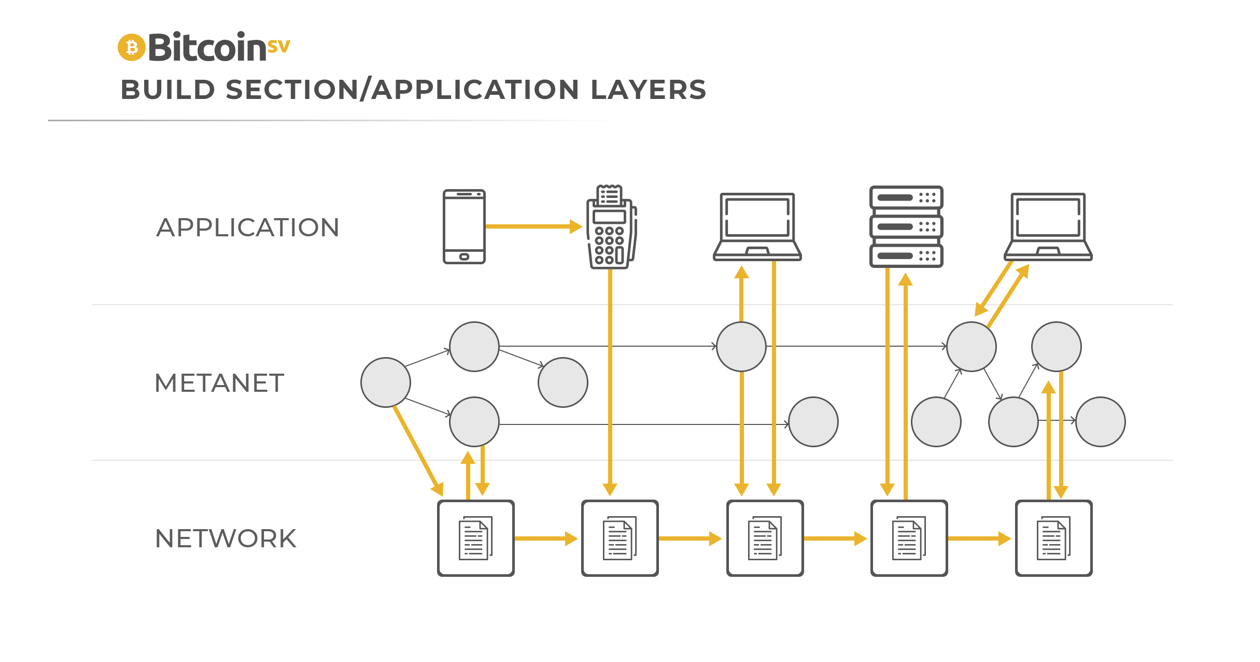
Image courtesy of: https://bitcoinsv.com/en/build-on-bsv/build-on-bitcoin-sv
One important distinction in the makeup of the system is that there are fiduciaries such as protocol developers and miners but no trusted third parties between the two people transacting together. That’s a key to the security and robustness of Bitcoin. Third parties are able to be compromised at some level including those breaches that could become catastrophic to both users and businesses alike. The difference is that if a node disappears for any reason, it has no real effect on the system.
The network itself is for the most part simplistic in form. Small nodes attach themselves to larger nodes creating an incentivized work structure. This peer-to-peer network prevents double spending of coins. Records cannot be changed because the block header would have to change. That would require changing the proof of work. Because nodes are incentivized for honest work, a malicious or intentional attack on a block would be outpaced by the rest of the nodes in the network performing honest work.
The system is automated in a manner that provides for a node to reconnect if for any reason they had to disconnect. In doing so, the node simply accepts the longest chain as proof of work. This will suffice to get them back up and running with the information they missed while they were offline. Their being offline also has no effect on the rest of the network.
While we have only scratched the surface, it really isn’t as complex as it may seem. To quote Dr. Wright referring to the complexity of the network “it just happens”.