
Written by :
Published on :
For decades, if you wanted to gamble legally in Finland, you went through Veikkaus. Full stop. The state-owned operator held an iron grip over everything. Lotteries, slots, sports betting, online casino games, in one of Europe's last true gambling monopolies. That era is now over in all but name.
Finland's new Gambling Act was approved by the president on January 16, 2026, with license applications opening March 1, 2026, and the fully competitive market set to launch on July 1, 2027. What happens between now and that launch date, and who emerges as market leaders on the other side, is shaping up to be one of the most closely watched stories in European iGaming.
The Numbers Behind the Reform
The monopoly collapse didn't happen in a vacuum. Veikkaus was losing the battle for Finnish players long before parliament voted to formalize its end.
Veikkaus' total GGR for 2025 was €931 million — a sharp decline from the €1.8 billion it enjoyed in 2017. The reason is obvious to anyone who has watched the European iGaming landscape over the past decade: Finnish players were voting with their wallets and heading offshore.
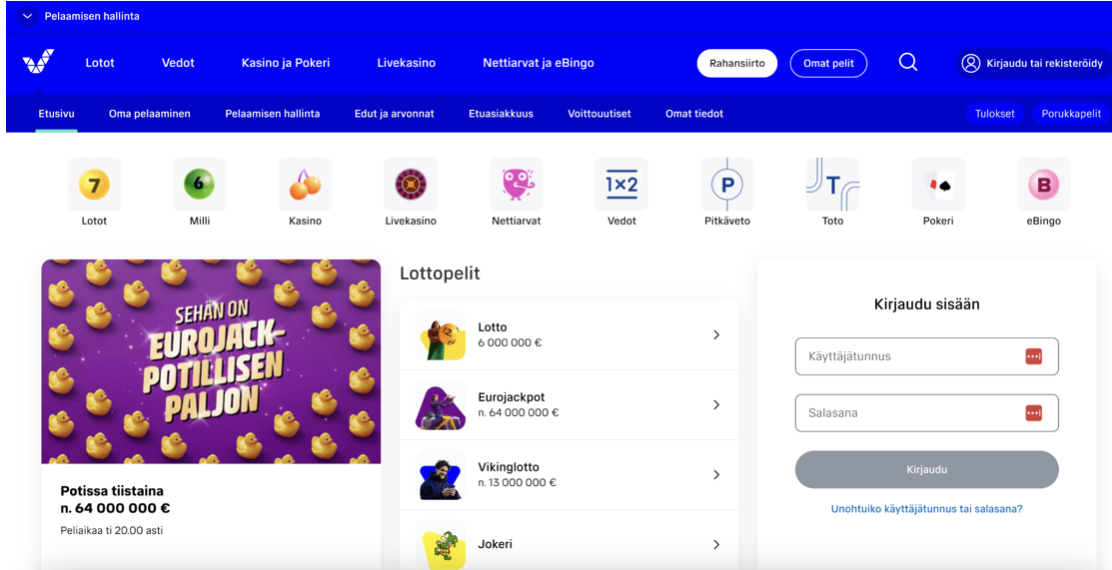
Veikkaus' own Deputy CEO Velipekka Nummikoski estimated that as much as €600–900 million is played annually outside the official system. Put simply, Finland had a black market problem that a monopoly framework was never going to solve. The reform is the government's acknowledgment of that reality.
GGR is expected to rise to €1.5 billion by 2029, driven by increased competition and player trust. That's the prize on the table, and plenty of operators have noticed.
The Race for Licenses
The speed at which the industry has moved is striking. In the first month alone, 24 operators submitted gambling license applications to the National Police Board — a mix of pan-European heavyweights and Nordic specialists. Confirmed applicants include Entain, Flutter Entertainment, Kindred Group, LeoVegas (now part of MGM Resorts), and Betsson. Industry insiders estimate 40 to 50 total licensees could be operational by market launch day.
For the first time, companies like Betsson, Kindred (FDJ United), and PokerStars could legally advertise and offer their platforms to Finnish customers. Provided they comply with Finnish rules and pay Finnish taxes.
Kindred (FDJ United) has been among the most vocal supporters of the reform. Joel Hakamies, general manager for Finland and Estonia at FDJ United/Kindred, said: "It's looking fairly good for the big picture. Overall it's been fairly positive from our view."
Betsson's path has been bumpier. The National Police Board removed Betsson from Finland's payment blocking list in October 2025, ending a 12-month sanction tied to a €2,400,000 penalty — clearing the company to seek a license under the new framework.
What Happens to Veikkaus?
Veikkaus isn't disappearing, but it is being fundamentally restructured, and a Bloomberg report published in April 2026 has added a dramatic new wrinkle to the story, a potential IPO.
The company will be split into two entities: one running the monopoly for lottery and land-based gaming, and the other competing in the online market on equal terms with private operators.
Bloomberg reported that Finland is actively taking steps toward a potential stock market listing of Veikkaus, with several milestones still to be met before the company would be ready for public markets. According to the report, Finland will only consider floating Veikkaus once three conditions have been met: the legislative changes must have taken effect, the timing must be right from a market perspective, and the company must have proven it can hold its own against rivals in a competitive environment.
Don't hold your breath for a quick listing, though. Maija Strandberg, Finland's Director General of Ownership Steering, told Finnish publication Kauppalehti that an IPO is not expected before the current government's term ends in April 2027, saying: "The market will open in the summer of 2027, and Veikkaus will need to demonstrate that it can compete in that market. We would then be at the end of 2028. If we take any action, we are approaching the turn of the decade."
There's also a parallel conversation happening about an outright sale. A former Veikkaus executive and Finnish Gambling Consultants partner said officials were also "considering selling Veikkaus through a direct sale in addition to a stock exchange listing," and that international gambling giants with deep pockets would be eager to buy the company now to cement a market-leading position from the very start of Finland's licensing era. However, he cautioned that any sale would be "influenced by politics" and that decisions would likely fall to the next government.
The move would allow the company to list on the Helsinki Stock Exchange and become at least partly privately owned — following a path blazed by France's FDJ United, which began its IPO in 2017 and has since become one of Europe's most important online gaming businesses.
In the meantime, Veikkaus' head of icasino and sportsbook, Jarkko Nordlund, said the new equal-playing-field framework removes the significant limitations the company previously faced around cross-selling and bonusing, presenting real growth opportunities in online casino.
The Market Is Already Shifting
Intriguingly, competition is already reshaping Finnish player behavior before a single license has been issued. Data tracking search interest shows that around mid-February 2026, new brands began appearing in the daily breakdown of Finnish gambling activity and Veikkaus' share visibly compressed — not gradually, but within days.
For Finnish players navigating this rapidly changing landscape, independent resources like kasinosivut.com are increasingly valuable for comparing incoming operators, evaluating bonuses, and understanding which sites are licensed versus offshore.
The Rules of the New Game
Finland's liberalized market won't be a free-for-all. Licensed operators will face a 22% GGR tax and annual supervisory fees, while a new Finnish Supervisory Agency takes over licensing and enforcement from the National Police Board on July 1, 2027, with powers to issue injunctions, impose fines, and revoke licenses.
Player protections will be extensive. Secondary regulation is expected to cover maximum permitted stakes and winnings, minimum game round duration, restrictions on autoplay, limits on near-miss features, and time-based tools such as mandatory breaks and play-time reminders.
Marketing will also be tightly controlled — a notable point for anyone in the affiliate space. Outright bans on affiliate marketing are included in the bill, and bonuses will only be permitted for existing customers.
The Bottom Line
Finland is one of the last big Western European markets to crack open, and the iGaming industry is treating it that way. The combination of a digitally sophisticated population, significant existing offshore activity, and a rising GGR ceiling makes it a high-stakes opportunity for whoever secures position early.
Finland represents one of the last major Western European markets still closed to competition — and with the licensing window now open and the clock ticking toward July 2027, the race to win Finnish players is already underway.
- B.E. Delmer, Gambling911.com