

Written by :
Published on :

Free picks are everywhere: on podcasts, in Discord servers, on social media and on hundreds of websites. Some are built on real work. Many are built to sell you something. The good news is that you can tell them apart in about five minutes, if you know what to look for.
The short answer: free sports picks are worth following only when the source posts every pick before the game with a timestamp, records the price it took, keeps every loss on a permanent public record, and has a sample of at least a few hundred picks. Without those four things, a win-loss record tells you almost nothing.
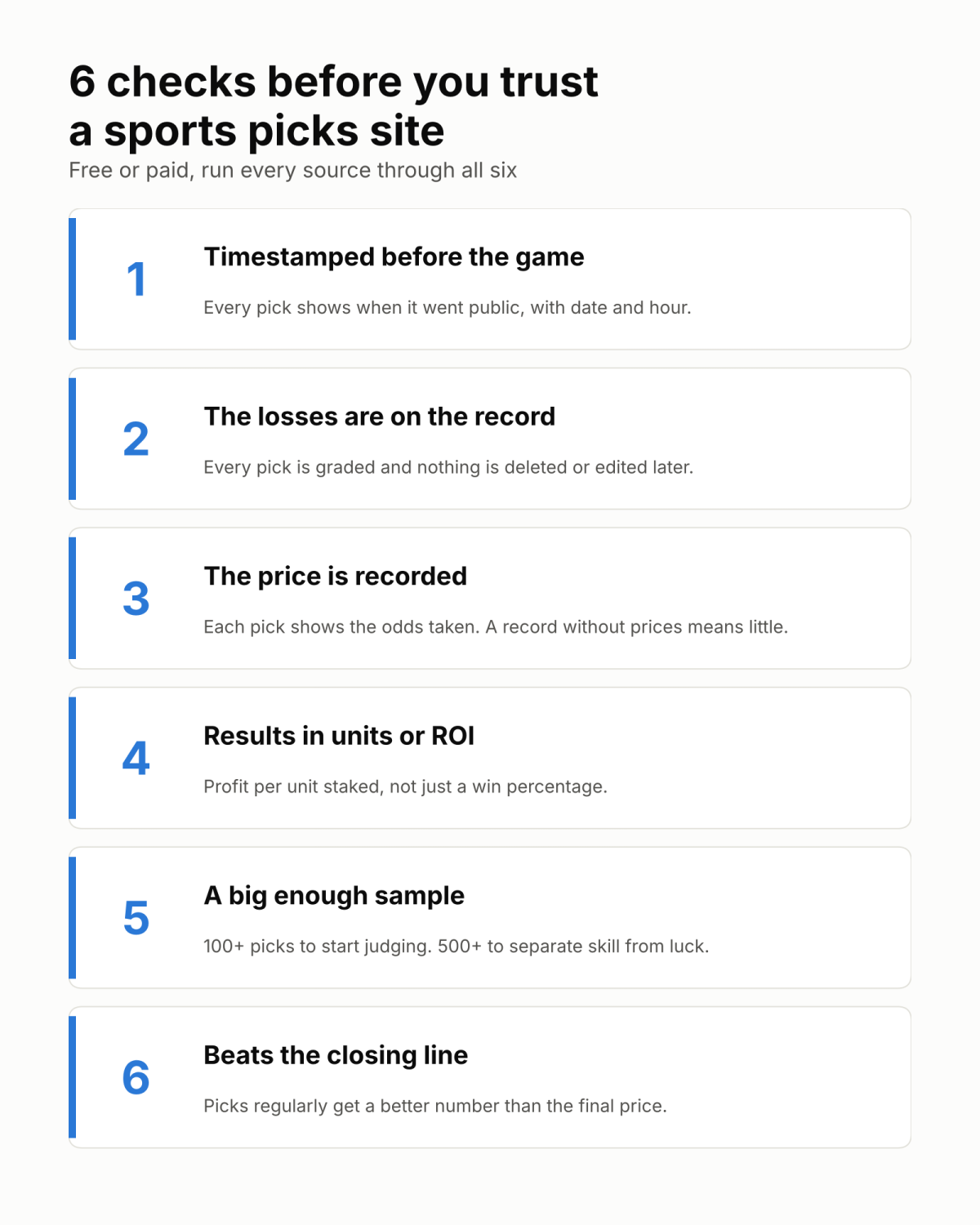
Here are the six checks to run before you put a dollar behind anyone's picks, free or paid.
Why are so many sports picks free?
Before judging a picks site, it helps to know how it makes money. Free picks are rarely charity. Most sites fall into one or more of these models:
- Sportsbook referrals. The site earns a commission when you open an account through its links. This is the most common model and is not a problem in itself, as long as the picks and the record are honest.
- Paid upsell. Free picks are bait for a VIP package. Watch for sites where the free picks are vague and the paid ones are promoted on every page.
- Advertising and audience. Podcasts, YouTube channels and media sites give picks away to build an audience they can sell ads against.
None of these models makes a site good or bad. What matters is whether the record can be checked. That is what the six checks below are for.
1. Is every pick posted before the game, with a timestamp?
This is the first filter, and it removes most sites. A pick only counts if it was public before kickoff. Look for a visible post time on each pick, ideally with the date and hour.
Be wary of records that appear after the fact, screenshots with no dates, or social posts that get deleted when they lose. If you cannot see when a pick was made, assume you cannot trust the result.
2. Does the record show the losses too?
Anyone can look like a genius by showing only the winners. A trustworthy site keeps a full, permanent record: every pick graded as won, lost or push, with nothing removed or edited after the game.
Some free sites now publish this openly. BettingPicks, for example, posts its free NFL picks with the price and the time of publication, then keeps every result on a public record, wins and losses alike. That is the standard to hold every source to.
3. Is the price recorded with every pick?
A win-loss record without prices tells you almost nothing. Winning 60% of your bets sounds great, but it depends entirely on the odds.
Suppose a tipster bets only heavy favorites at -200 and wins 60% of the time. Over 100 bets of $100:
- 60 wins at -200 pay $50 each: +$3,000
- 40 losses cost $100 each: -$4,000
- Net result: -$1,000
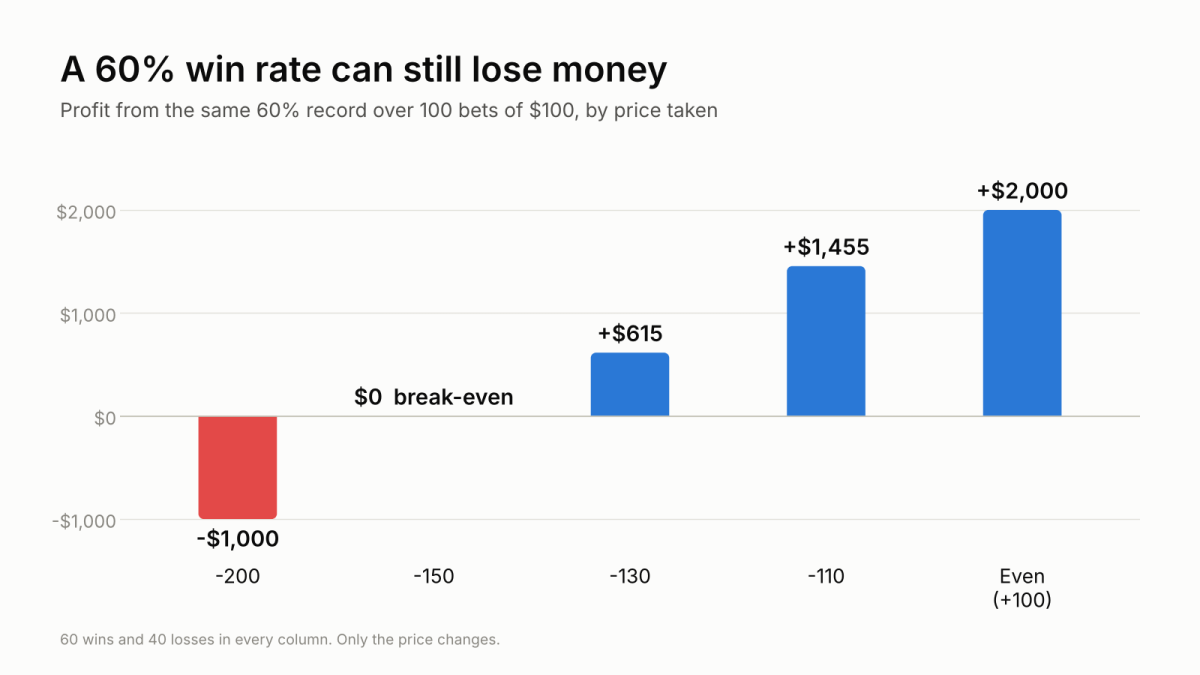
At -200 you need to win 66.7% just to break even. A 60% record that looks impressive is actually losing money. The same 60% at -110 would make $1,455. Always check the price at the time of the pick, not just the result.
4. Is the record in units or ROI, not just win rate?
Because of the point above, serious handicappers report results in units won or lost, or as return on investment. A unit is a standard stake, usually 1% of a bankroll.
ROI is simple to work out: total profit divided by total amount staked. A source that is +12 units after 300 one-unit picks has an ROI of 12 ÷ 300 = 4%. That tells you far more than "62% winners". If a site shows only win percentage and hides units or ROI, ask yourself why.
5. Is the sample big enough to mean anything?
Short hot streaks happen to everyone, including people flipping coins. A 20-8 run over a few weeks is mostly noise.
The chart below shows the range of win rates a bettor with zero skill could post just by luck, 95% of the time, at different sample sizes. Over 30 picks, a coin-flipper can land anywhere from 32% to 68%. Over 100 picks, anywhere from 40% to 60%. Only past a few hundred picks does luck stop hiding skill.
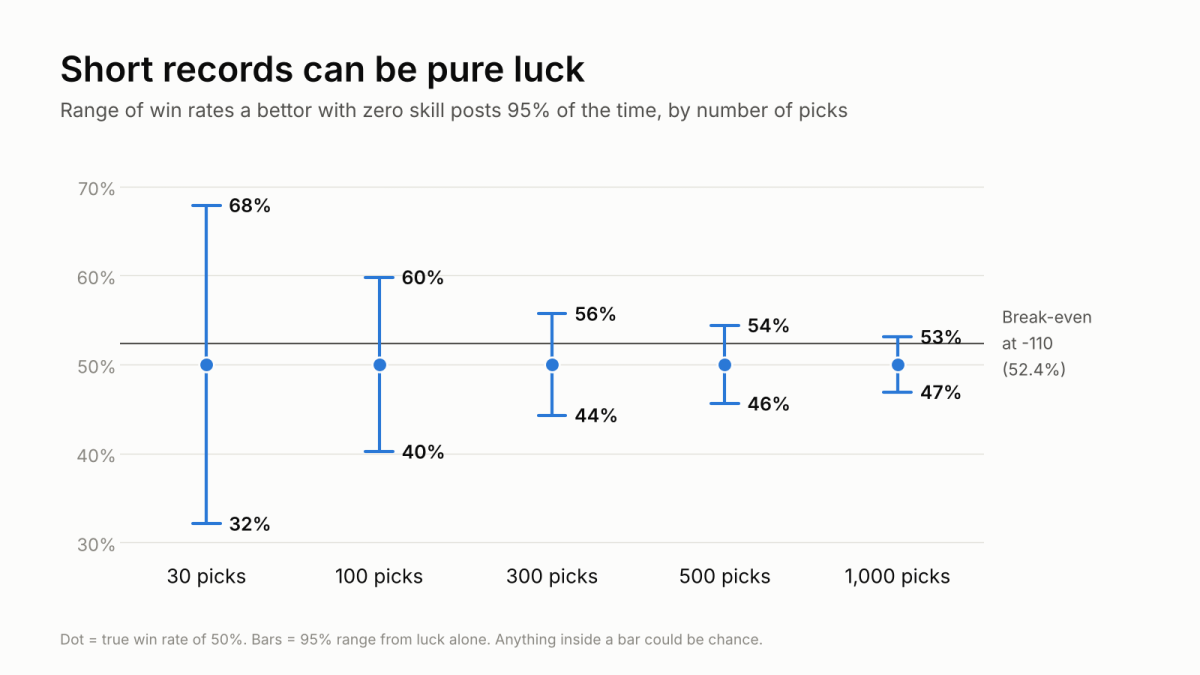
The 95% luck range for a bettor with no edge (true win rate 50%). Records inside the band could be pure chance.
As a rough guide:
- Under 100 picks: too early to judge anything.
- 100 to 300 picks: starting to mean something, especially with prices attached.
- 500+ picks: enough to separate skill from luck with some confidence.
The longer the public record, the more it is worth. That is another reason a site that never deletes picks is worth more than one that resets its record every season.
6. Do the picks beat the closing line?
This is the check professionals care about most. The closing line is the final price before the game starts, and it is the most accurate price the market produces.
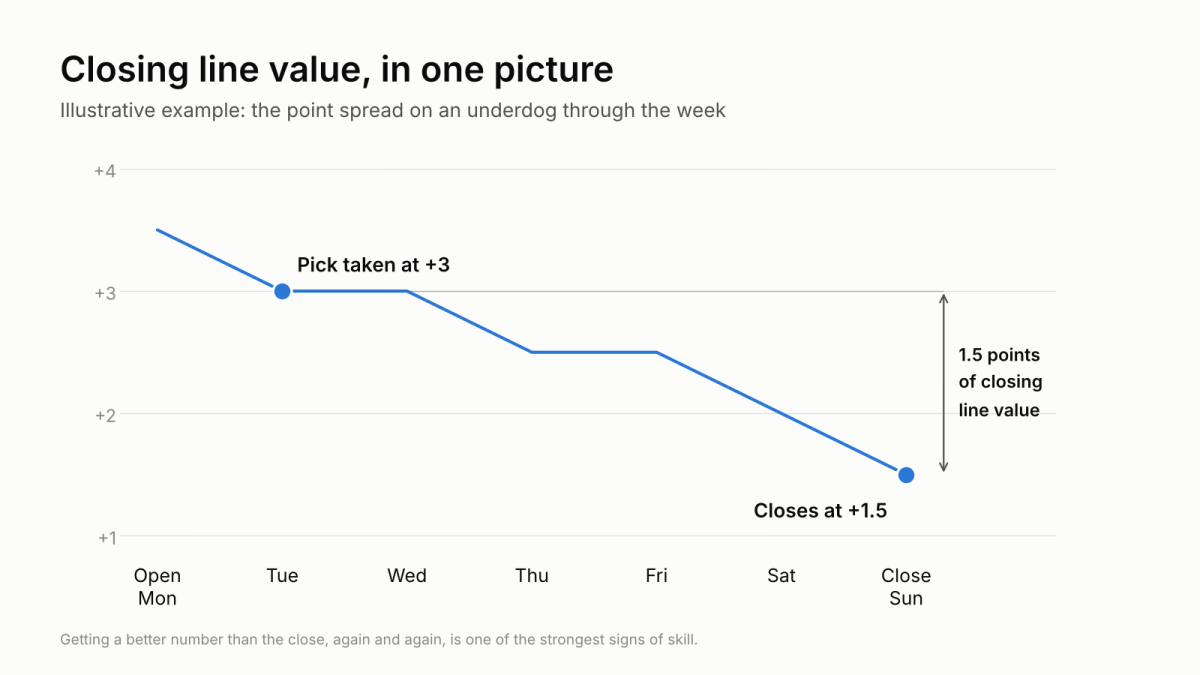
Closing line value: the pick was taken at +3 and the market closed at +1.5, so the bettor beat the close by 1.5 points.
If a source regularly gets a better number than the close, for example taking a team at +3 that closes at +1.5, it is consistently finding value before the market does. Over time, beating the closing line is a stronger sign of skill than any win-loss record. If a site records the price at publication, you can check this yourself against the closing odds.
How to track a picks source yourself
The best way to know whether picks are worth following is to track them yourself for a few weeks before betting real money. A simple spreadsheet with these columns is enough:
| Column | What to record | Why it matters |
|---|---|---|
| Date and time posted | When the pick went public | Proves it was made before the game |
| Pick | Team, bet type and line | Shows exactly what was bet |
| Price at publication | The odds when posted | Needed for profit and ROI |
| Best price available | The best odds you could actually get | Shows what you would really have earned |
| Closing price | The odds just before the game | Measures closing line value |
| Result | Won, lost or push | The record itself |
| Profit in units | Units won or lost at 1 unit per pick | Gives you ROI over time |
After 100 picks, you will know more about a source than any marketing page can tell you.
Free picks vs paid picks
| Free picks | Paid picks | |
|---|---|---|
| Cost | Nothing | A weekly, monthly or per-pick fee |
| Break-even bar | Same as your bets: 52.4% at -110 | Higher: the picks must also cover the subscription |
| How the source earns | Referrals, ads, audience | Subscriptions |
| What to check | The same six checks | The same six checks |
Paying for picks does not make them better. A paid service has to win by enough to cover its own fee before you see a dollar of profit, so it needs to pass the six checks even more clearly than a free source.
Red flags that should end the conversation
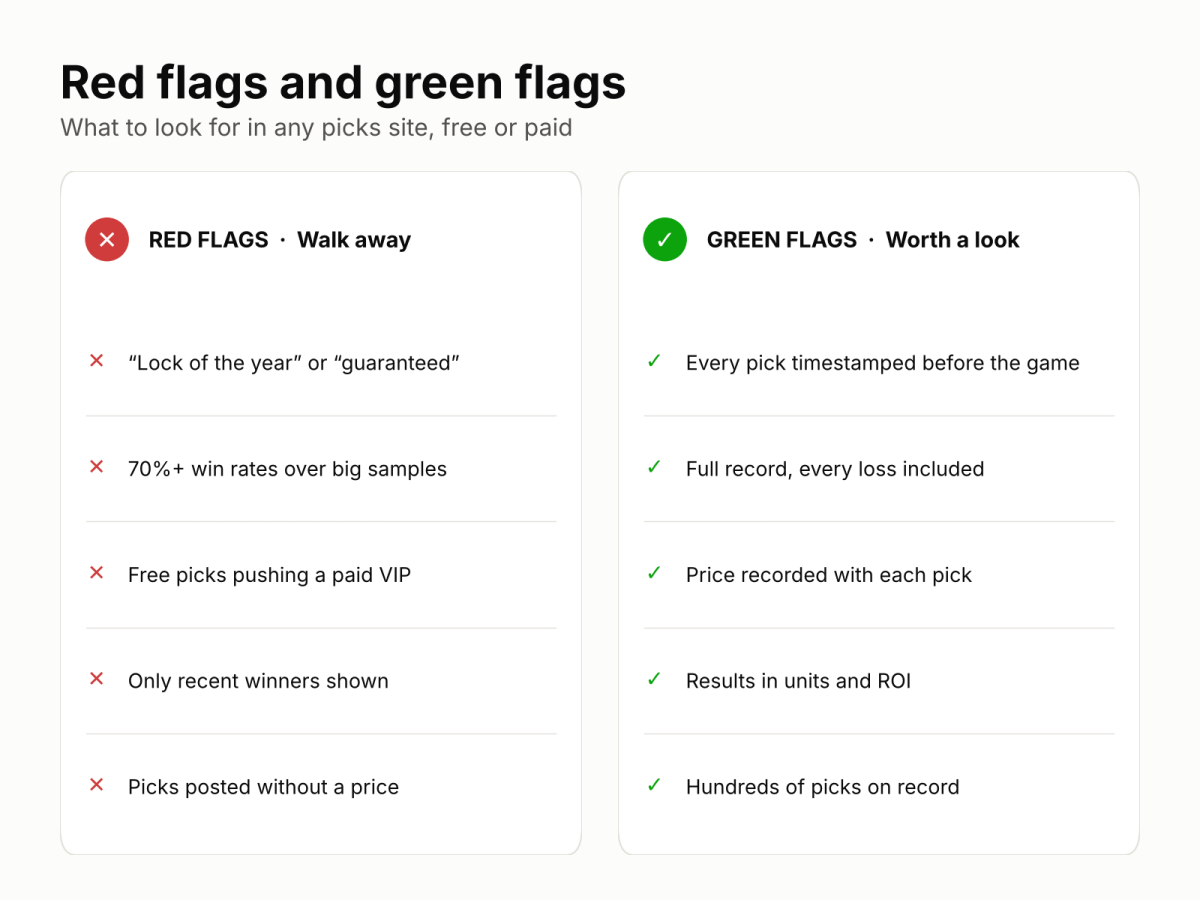
- "Lock of the year" or "guaranteed winner" language. There is no such thing.
- Win rates above 70% claimed over large samples.
- Free picks used mainly to push a paid VIP package.
- No record at all, or one that only shows recent winners.
- Picks posted without a sportsbook price.
Free sports picks FAQ
Are free sports picks legit?
Some are and some are not. A legitimate source posts picks before the game, records the price, keeps every loss on a public record and has a large enough sample to judge. Run any source through the six checks above before trusting it.
What win rate is good in sports betting?
At the standard -110 price, you need to win 52.4% of bets to break even. Sustaining 55% over several hundred bets at that price is excellent. Win rates must always be read alongside the prices taken.
How many picks do I need before I can judge a tipster?
At least 100 to start forming a view, and 500 or more to separate skill from luck with some confidence. Fewer than 100 picks is mostly noise.
What is a unit in sports betting?
A unit is a standard stake, usually 1% of your bankroll. Reporting results in units lets you compare sources fairly, whatever their stake sizes.
What is closing line value?
Closing line value is the difference between the price you took and the final price before the game. Consistently getting a better number than the close is one of the strongest signs of a skilled bettor.
So, are free picks worth following?
They can be, as long as the source passes these checks. A free pick with a timestamp, a recorded price and a permanent public record is more trustworthy than a paid pick with none of those things.
Use free picks as one input, not as orders. Compare them with the odds, check where the public money is going, shop for the best price, and stake sensibly. The best picks site in the world cannot fix a bad price or a bankroll that is bet too heavily.
21+ only. Gambling problem? Call 1-800-GAMBLER.
- B.E. Delmer, Gambling911.com