

Written by :
Published on :
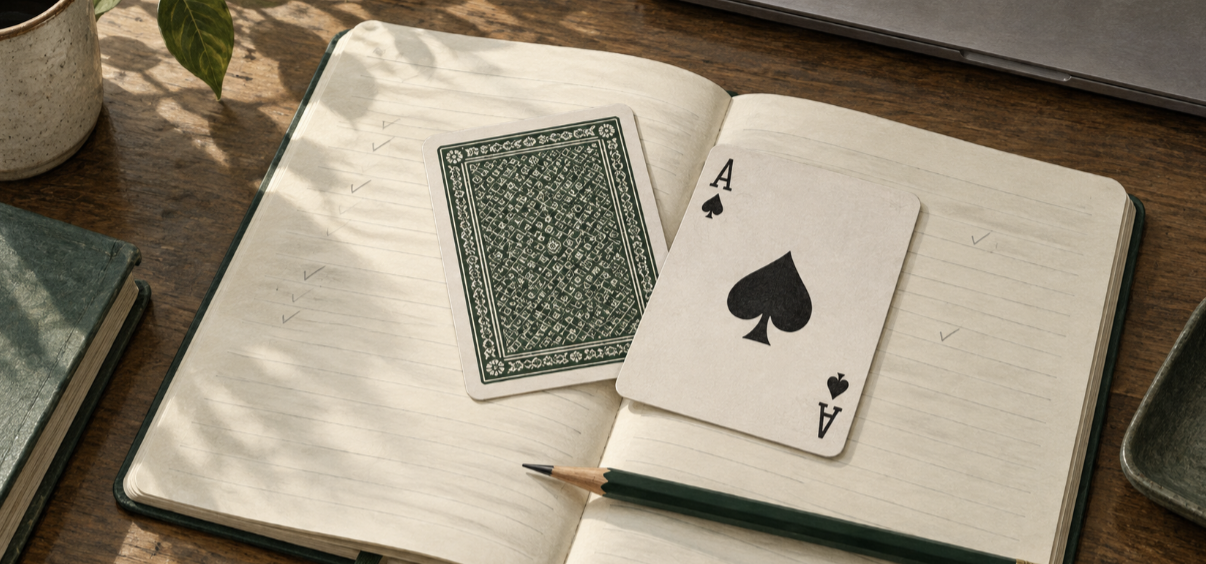
Anonymous poker tables can hide an opponent's account name without erasing the hand you played. A replay preserves the action, and a fuller record may later reveal cards you never saw. For a useful review, separate those two views: the information available when you acted and the information that appeared afterward. Knowing the ending can make a difficult decision seem obvious, even though the relevant cards were still hidden when you had to choose.
Saving information is also different from remembering it. In research reported by PsyPost, participants remembered artwork they screenshotted less well than artwork they simply viewed. They couldn't review their screenshots before testing, so the findings don't assess deliberate poker study, but they still give us some information about how human memory works. A saved hand needs to be reopened and examined to be useful in many cases. Use the record to establish what happened, and keep your recollection of why you acted separate from the recorded action.
Anonymity concerns the recognition of the person behind the cards. In the anonymous games available on Ignition Poker, assigned numbers replace user IDs, while hand histories remain available for review. The hand-history viewer lets players move backward and forward through previous hands. Complete downloadable histories become available 24 hours after the conclusion of a scheduled tournament, Sit & Go, or cash game. These reveal every player's hole cards (the cards dealt privately), including those belonging to players who folded.
The full record answers a question you couldn't necessarily settle during play: what an opponent actually held. Reviewing your decision asks something different: whether your action made sense given the information available when it was your turn.
Reconstruct the decision
Start with one decision you want to understand. Trying to explain every action in a hand at once makes it harder to identify where your reasoning changed. Choose the call, fold, check, or bet that left you uncertain, then reconstruct the hand up to that point.
Record your own cards, the shared cards already visible, the betting sequence, the pot size, and the chips remaining. Note who had acted and who still had a decision to make. These details describe the situation you faced; cards exposed later belong elsewhere in your notes.
Then write down the reason you remember considering the action you took. Distinguish a recollection from something you recorded during play. If you can't remember your reasoning, leave that uncertainty visible. Filling the gap with an explanation that fits the ending would give you a tidier story, but an inaccurate account of your decision.
Make a note before the complete history becomes available, recording the session and decision you want to revisit. A note made after play is still a recollection. Keep that version and add later corrections underneath. This lets you compare your original interpretation with what you thought after seeing the hidden cards.
Consider which opposing hands the visible action could reasonably represent. There may have been several possibilities. Keep the alternatives you considered separate from the cards the opponent eventually showed. An earlier observation can inform that assessment, but record the observation itself, rather than turning it into a fixed label for the player.
Add the revealed cards
Only after setting out the original decision should you examine what the complete history adds. If you've already seen the hidden cards, you can't undo that knowledge, but you can still mark them as information learned afterward and avoid using them to rewrite your earlier explanation.
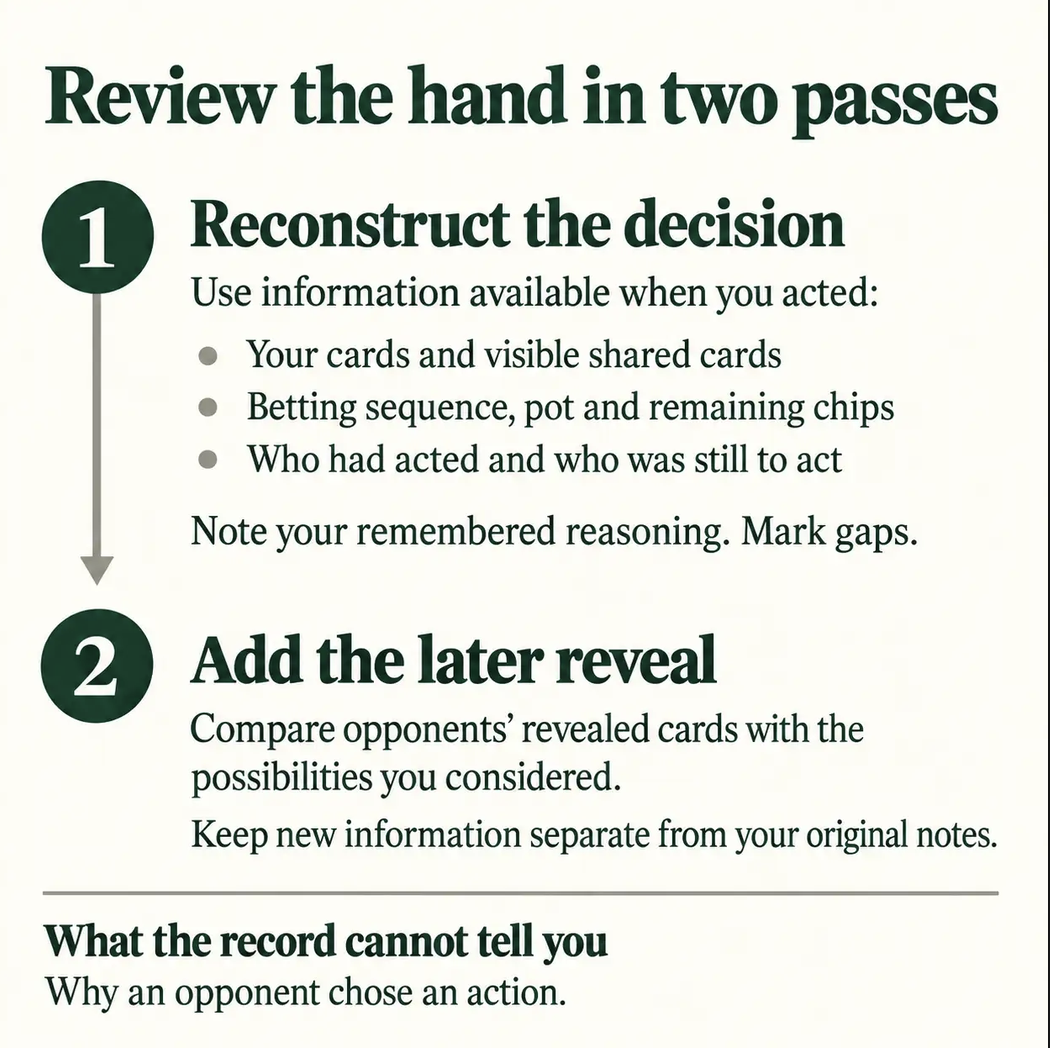
Compare the revealed holding with the possibilities you identified. Was it something you had considered? Did you overlook a relevant feature of the board or the betting sequence? Or did the reveal simply settle an uncertainty that the available information couldn't resolve?
In this video, Master the Mental Game: Poker Psychology Explained, the discussion of frustration turns toward asking what can be learned from a hand and whether anything was missed. Apply that question to the decision you've reconstructed: identify a visible action you overlooked or an assumption the later cards challenge. An unexpected holding alone doesn't establish that your reasoning was unsound. Nor does correctly anticipating the cards prove that every part of the decision was justified.
The record also has limits. It can establish the cards and actions, but it doesn't record an opponent's reasons for their choices. A single revealed hand cannot establish how that person would act across every similar situation. Keep the conclusion attached to the hand actually documented.
Keep the lesson specific
Reviewing a hand also means examining how certain you were – something it's always worth paying attention to in games that are heavy on decision-making. Keep a short note of what you knew, what the later record added, and what remains unresolved. The useful lesson may concern an action you missed, a possibility you dismissed, or a reason you cannot now reconstruct. It needn't become a sweeping rule about anonymous opponents.
Finish by choosing one question for a future review. That might concern your attention to the betting sequence or whether your explanation accounts for all the information available at the decision. The next hand you examine can help you investigate that question. It cannot retroactively supply knowledge you lacked in the previous one.
- Ace King, Gambling911.com